All articles
Blog
WhatsApp API vs SMS Marketing: Which Channel Delivers Better Business Results in 2026?
W
Wonestop Team
Jun 9, 2026 · 5 min read
Wonestop Team
Jun 9, 2026 · 5 min read
For years, SMS marketing was one of the most common ways businesses communicated with customers. From OTP verification and appointment reminders to promotional offers and delivery updates, SMS became a trusted communication channel for businesses across industries.
But customer behavior has changed.
Today, customers expect quick responses, personalized communication, and seamless support. Businesses are no longer looking for channels that only deliver messages. They want communication platforms that improve engagement, build relationships, and create better business outcomes.
This shift has led many companies to compare the WhatsApp Business API vs SMS Marketing.
The real question is no longer which channel is cheaper.
The real question is
Which communication channel generates better engagement, stronger customer relationships, and higher ROI?
Before comparing results, it is important to understand how both channels work.
SMS marketing allows businesses to send short text messages directly to customers.
Businesses commonly use SMS for:
One of the biggest advantages of SMS is accessibility. It works on almost every phone and does not require internet access.
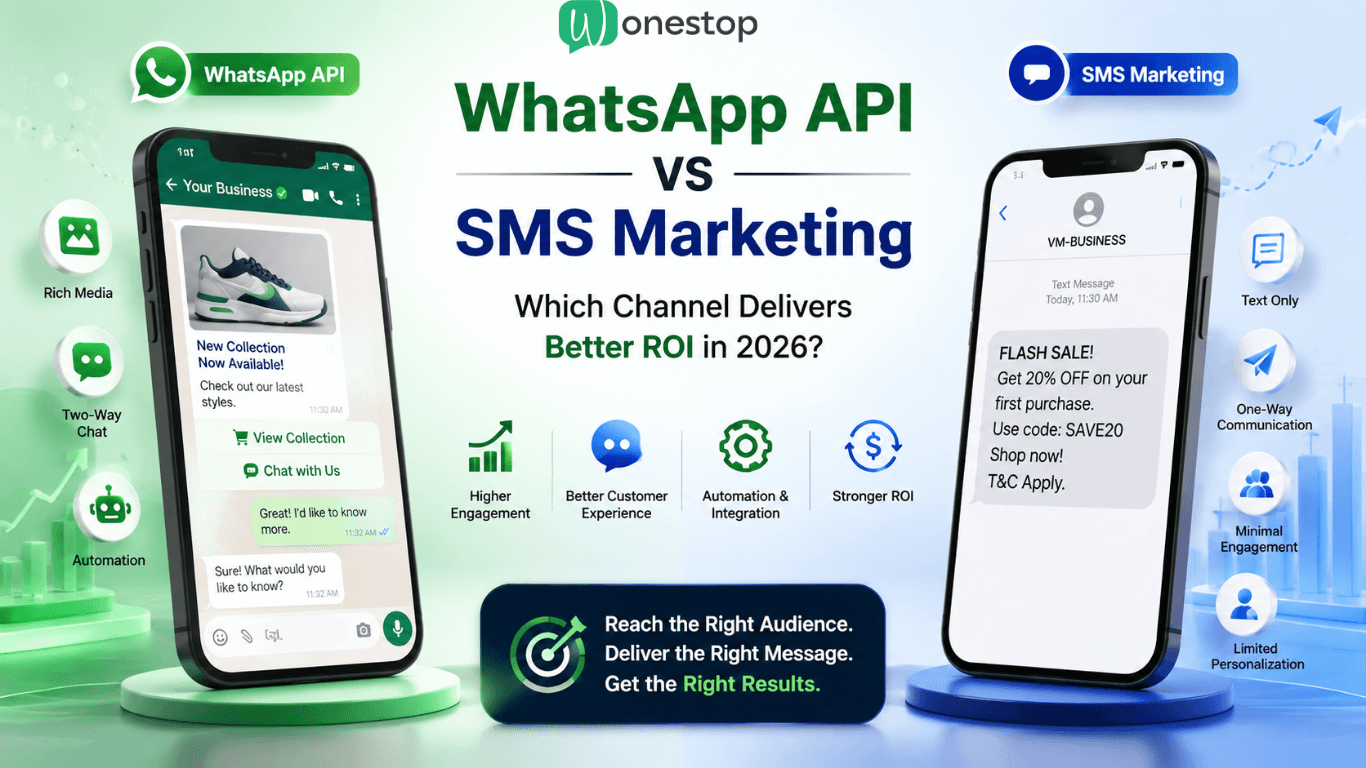
However, SMS communication is generally limited to plain text and one-way messaging.
The WhatsApp Business API allows businesses to communicate with customers at scale through WhatsApp.
Unlike SMS, WhatsApp supports:
Most importantly, customers can instantly continue the conversation in the same chat.
Instead of receiving a message and leaving the platform, users can ask questions, request information, and interact with businesses immediately.
| Feature | WhatsApp Business API | SMS Marketing |
| Rich Media Support | Yes | No |
| Images & Videos | Yes | No |
| Two-Way Communication | Yes | Limited |
| Chat Automation | Yes | Limited |
| CRM Integration | Yes | Limited |
| Interactive Buttons | Yes | No |
| Customer Support | Strong | Basic |
| Lead Nurturing | Strong | Moderate |
| Internet Required | Yes | No |
| Reach | High | Very High |
Both channels have strengths, but they serve different purposes.
One of the biggest reasons businesses prefer WhatsApp today is simple:
Customers are already active there.
Most people check WhatsApp several times a day.
SMS inboxes are often crowded with banking alerts, promotional messages, spam communication, and service notifications. This makes it harder for businesses to grab customer attention.
WhatsApp creates a more natural communication experience.
For example, if a business sends a product update through WhatsApp, customers can instantly:
without leaving the app.
This often improves engagement and reduces friction in the customer journey.
Many businesses compare communication channels based only on messaging costs.
But ROI depends on much more than cost per message.
A communication channel should be evaluated based on:
For example, if a communication channel generates more customer conversations, improves follow-ups, and creates better conversion opportunities, the long-term return may be much higher.
This is where WhatsApp Business API often delivers stronger business value.
Instead of one-way messaging, businesses can build ongoing customer conversations.
WhatsApp allows businesses to send rich media content such as images, videos, brochures, and catalogues.
A product image or service brochure often communicates far better than plain text.
Businesses can showcase:
inside one conversation.
Customers expect quick responses.
With the WhatsApp API, businesses can automate the following:
This reduces response time and improves customer satisfaction.
Many businesses lose leads due to slow follow-ups.
WhatsApp API helps businesses automate reminders, nurture leads, and continue conversations at different stages of the customer journey.
This is especially useful for industries like real estate, healthcare, education, e-commerce, and finance.
Despite the growth of WhatsApp, SMS still remains valuable in many situations.
SMS works best for:
Banks, fintech companies, and online platforms continue using SMS for authentication.
Urgent alerts and service updates often require maximum reach, even when internet access is unavailable.
SMS can reach customers on almost any mobile device.
For many businesses, SMS is not being replaced completely. Instead, it works alongside WhatsApp.
Rather than choosing one channel, many businesses use both strategically.
This combination helps businesses maximize reach while improving customer experience.
The answer depends on your business goals.
If your primary goal is simply delivering notifications, SMS remains effective.
However, if you want to:
then WhatsApp Business API offers significantly broader capabilities.
Businesses focused on long-term customer engagement are increasingly investing in WhatsApp as a growth channel.
Whether you want to automate customer support, recover leads, send updates, improve customer engagement, or create personalized customer communication, the right WhatsApp API setup can help your business communicate faster and more efficiently.
At Wonestop, we help businesses implement the official WhatsApp Business API with automation, CRM integration, chatbot setup, customer engagement workflows, and scalable communication solutions tailored to business needs.
Whether you are in e-commerce, healthcare, education, real estate, finance, or service industries, our team helps businesses create smooth customer communication experiences that improve response times and customer engagement.
Want to know how WhatsApp API can work for your business? Get in touch with Wonestop and explore the right communication solution for your business growth.
The debate around WhatsApp API vs. SMS Marketing is not really about choosing a winner.
It is about understanding how customer communication has evolved.
SMS still plays an important role, especially for OTPs, urgent alerts, and transactional communication.
However, businesses looking to improve engagement, automate communication, nurture leads, and create better customer experiences are increasingly adopting WhatsApp Business API.
As customer expectations continue to rise, businesses that communicate where customers are most active will have a stronger advantage.
Book a quick demo and we'll get your business live on the official WhatsApp Business API — fast.