All articles
Blog
WhatsApp Chatbot vs. AI WhatsApp Chatbot: What’s the Difference?
W
Wonestop Team
Aug 18, 2026 · 6 min read
Wonestop Team
Aug 18, 2026 · 6 min read
Customers expect quick answers on WhatsApp. But as enquiries grow, replying to every message manually can take up a lot of your team’s time.
That is where WhatsApp chatbots and AI WhatsApp chatbots can help.
Both can automate conversations, capture leads, answer common questions, and reduce repetitive work. The difference is how they handle the conversation.
A regular WhatsApp chatbot follows predefined workflows. An AI WhatsApp chatbot uses AI and relevant business information to handle more flexible customer questions.
So, which one is right for your business? Let’s look at the difference.
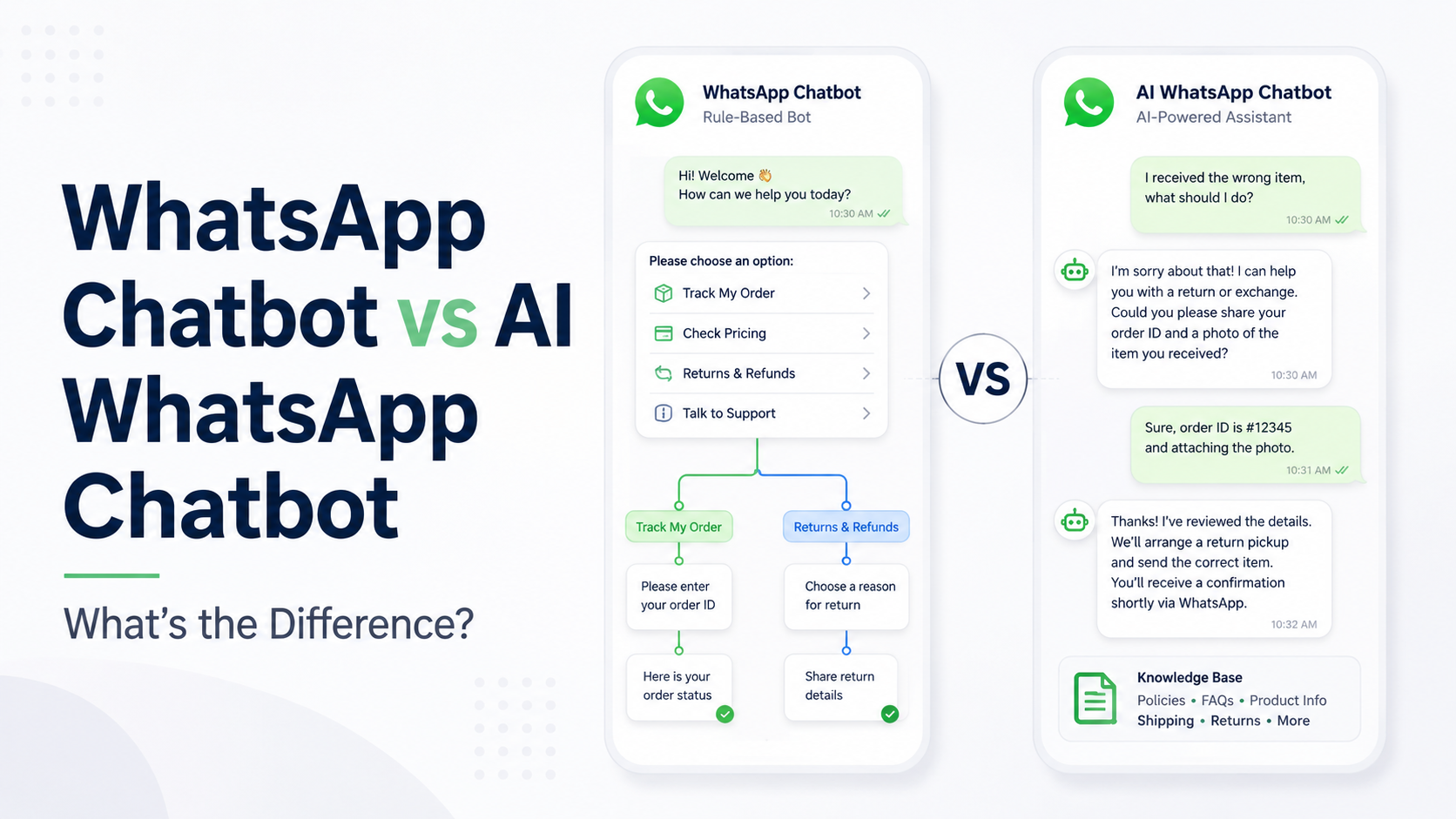
A WhatsApp chatbot is a rule-based automation tool that responds to customer messages through predefined conversation flows.
For example, when a customer sends:
“Hi”
They may receive:
How can we help you today?
The customer’s selection determines what happens next.
With Wonestop’s no-code WhatsApp Chatbot, businesses can build customer journeys using buttons, quick replies, lists, conditions, and automated responses without writing code.
It can help businesses:
A rule-based chatbot works best when customer journeys are predictable and can be organized into clear steps.
An AI WhatsApp Chatbot is an AI-powered virtual assistant that communicates with customers on WhatsApp.
Instead of depending only on fixed menus, it can handle more natural customer questions and provide relevant responses using information from the business knowledge base.
With Wonestop, an AI WhatsApp chatbot can be configured with your FAQs, products, services, and other business information.
It can help businesses:
Wonestop also provides conversation analytics to help businesses understand common customer questions, customer behavior, and chatbot performance.
The main difference is how each chatbot handles customer conversations.
| WhatsApp Chatbot | AI WhatsApp Chatbot |
| Uses predefined, rule-based flows | Uses AI-powered conversations |
| Best for structured customer journeys | Better for varied customer questions |
| Uses buttons, lists, and quick replies | Uses business information to answer questions |
| Captures leads | Captures and helps qualify leads |
| Supports appointment booking | Supports appointment booking |
| Route conversations | Guides customers through more flexible conversations |
| Supports human handover | Supports human handover |
| Uses a no-code workflow builder | Can use a business knowledge base |
Both are useful. The right choice depends on how your customers communicate with your business.
For example, a regular WhatsApp chatbot might ask a customer to choose pricing, products, or support from a menu. An AI WhatsApp chatbot can handle a question such as, “Which option would be suitable for my business?” and respond using the relevant business information available to it.
Choose a WhatsApp chatbot when most customer conversations are predictable.
For example, customers may regularly ask:
A rule-based chatbot works well when you want customers to choose from clear options and move through a defined journey.
It is particularly useful for:
If your customer journey can be mapped into clear steps, a regular WhatsApp chatbot may be all you need.
An AI WhatsApp chatbot is useful when customers ask questions in different ways and your business needs more flexible automated conversations.
Instead of forcing customers to select from a menu, an AI chatbot can use information from the business knowledge base to respond to customer questions, identify requirements, collect relevant details, and help qualify leads before passing them to your sales team.
This can be useful for businesses that receive a wider variety of customer questions.
An AI WhatsApp chatbot can be a good fit when:
The goal is not to use AI simply because it is more advanced. It is to use AI where it can make the customer experience more useful and efficient.
Yes.
Automation should not force customers to speak only with a chatbot. Both Wonestop’s WhatsApp Chatbot and the AI WhatsApp Chatbot support human handover.
When a conversation needs personal assistance, it can be transferred to your sales or support team.
For example, a chatbot can handle an initial enquiry, collect customer information, and then hand the conversation over to a sales representative when the customer is ready to discuss specific requirements.
This creates a practical balance:
Automation handles routine conversations, while your team manages situations that require human attention.
There is no single chatbot that is right for every business.
Choose a WhatsApp Chatbot if you need:
Choose an AI WhatsApp Chatbot if you need:
A simple way to decide is
Predictable conversations → WhatsApp Chatbot
More dynamic conversations → AI WhatsApp Chatbot
Your final choice should depend on your customer journey, the questions customers ask, and the level of automation your team needs.
Wonestop is a Mumbai-based WhatsApp Business platform built on the Meta WhatsApp Business API.
For structured automation, businesses can use its no-code WhatsApp Chatbot builder to create workflows with buttons, lists, conditions, quick replies, automated responses, and human handover.
For AI-powered customer conversations, Wonestop provides an AI WhatsApp chatbot that can be configured with products, services, FAQs, and other business information.
Businesses can also connect their chatbot and WhatsApp workflows with CRM software, websites, APIs, Shopify, WooCommerce, and other business tools.
This allows businesses to use WhatsApp not only for answering customer questions but also for lead generation, customer support, sales follow-ups, and broader customer communication.
Both WhatsApp chatbots and AI WhatsApp chatbots can reduce repetitive customer queries and help teams respond faster.
A WhatsApp chatbot is ideal for predefined and structured customer journeys. An AI WhatsApp chatbot is better suited to flexible conversations, knowledge-based responses, and conversational lead qualification.
You do not need AI for every customer journey.
If your conversations are simple and predictable, a rule-based WhatsApp chatbot may be the more practical choice. If customers regularly ask open-ended questions, an AI WhatsApp chatbot can provide greater flexibility.
Don’t choose AI just because it sounds more advanced. Choose the chatbot that matches how your customers actually communicate with your business.
A WhatsApp chatbot uses predefined, rule-based conversation flows. An AI WhatsApp chatbot uses AI-powered conversations and can provide responses using relevant information from a business knowledge base.
Book a quick demo and we'll get your business live on the official WhatsApp Business API — fast.