All articles
Blog
WhatsApp Marketing vs Email Marketing: What Works Better for Businesses?
W
Wonestop Team
May 13, 2026 · 7 min read
Wonestop Team
May 13, 2026 · 7 min read
Most businesses are facing the same problem today.
Customers scroll past promotional emails without opening them, but reply to WhatsApp messages within minutes. Inbox fatigue is growing, attention spans are shorter, and businesses are under pressure to communicate faster than ever.
This shift in customer behavior has changed how brands approach digital communication.
While email marketing still plays an important role, WhatsApp marketing is becoming one of the fastest-growing customer engagement channels for businesses. From e-commerce brands and startups to service providers and local businesses, companies are now using messaging platforms to create faster, more direct customer conversations.
So which one actually works better?
The answer depends on what your business wants to achieve.
If you want detailed communication and long-term nurturing, email marketing still has value. But if your goal is instant engagement, faster responses, and better customer interaction, WhatsApp marketing often delivers stronger results.
Let’s break down both channels properly and understand where each one works best.
WhatsApp marketing is the process of communicating with customers through WhatsApp using promotional messages, updates, reminders, support chats, and automated conversations.
Unlike traditional marketing channels, WhatsApp feels personal. Messages arrive directly on a customer’s phone, which naturally increases visibility and engagement.
Businesses commonly use WhatsApp marketing for:
With WhatsApp Business API and automation tools, businesses can now handle customer communication at scale while still maintaining personalized interactions.
This is one of the biggest reasons why WhatsApp business marketing is growing rapidly across industries.
Email marketing is a digital marketing strategy where businesses send emails to subscribers or customers for promotions, updates, newsletters, educational content, and sales communication.
For years, email marketing has been one of the most reliable channels for customer retention and lead nurturing.
Businesses use email marketing for:
Email works especially well when businesses need to share detailed information in a structured format.
Even today, email marketing for businesses remains effective for B2B communication, long-form content, and relationship building.
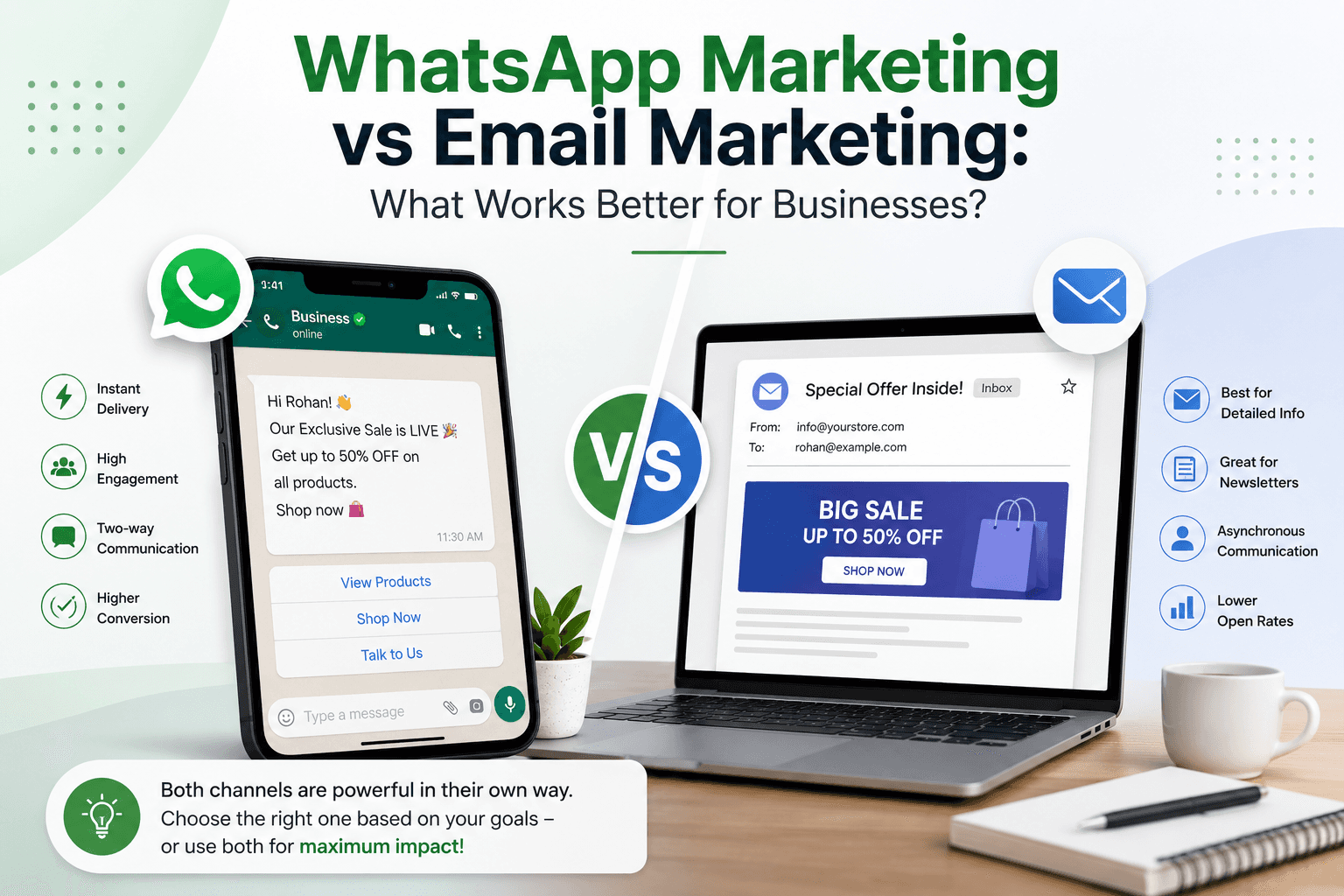
Both platforms are useful, but they work differently depending on customer behavior and communication goals.
| Feature | WhatsApp Marketing | Email Marketing |
| Open Rates | Extremely high | Moderate |
| Response Speed | Fast | Slower |
| Customer Engagement | More interactive | Lower interaction |
| Personalization | Highly personal | Moderately personalized |
| Automation | Real-time automation | Workflow automation |
| Conversion Potential | Strong for instant action | Better for long-term nurturing |
| Customer Support | Excellent | Limited |
| Best Use Cases | Promotions, reminders, support | Newsletters, reports, education |
WhatsApp marketing generally gets much higher open rates than email marketing.
Most people check WhatsApp several times throughout the day, while emails often remain unread for hours or even days.
Industry studies regularly show that WhatsApp messages can achieve open rates above 90%, while average email open rates are significantly lower.
That difference matters because visibility directly affects conversions.
For example:
This is one reason businesses are shifting toward conversational marketing channels.
WhatsApp clearly performs better for response speed.
Customers naturally treat WhatsApp as a real-time communication platform. Emails, on the other hand, are often checked less frequently.
Businesses that depend on fast interaction usually see better engagement through WhatsApp.
This includes:
For example, a customer asking about product availability on WhatsApp is more likely to continue the conversation immediately compared to email communication.
Faster responses also improve sales opportunities.
Businesses today want communication channels that feel natural, quick, and customer-friendly.
That is exactly why WhatsApp marketing is growing so fast.
Modern customers do not want delayed responses. They expect businesses to reply quickly, especially on mobile devices.
WhatsApp helps businesses meet those expectations.
Most online traffic now comes from smartphones. Since WhatsApp is already part of daily mobile behavior, engagement rates tend to be stronger.
WhatsApp messages feel more human compared to promotional emails.
Businesses can:
This creates stronger customer relationships.
Businesses can now automate:
Modern customer engagement platforms like Wonestop help businesses automate communication while maintaining personalized customer experiences.
Even though WhatsApp marketing is growing rapidly, email marketing still works well in many situations.
Emails are better for:
WhatsApp works best for shorter communication.
Formal business communication is still more trusted through email, especially in B2B industries.
Email platforms are effective for managing massive subscriber lists and scheduled campaigns.
Email sequences are useful for moving leads through longer sales cycles.
For example, SaaS businesses often rely heavily on email onboarding campaigns to educate users gradually.
For small businesses, communication efficiency matters more than ever.
Most small businesses cannot afford to lose customer attention through slow or ineffective communication.
That is why many small brands now prefer WhatsApp marketing for:
A local salon can use WhatsApp reminders to reduce missed appointments.
An e-commerce store can recover abandoned carts through quick WhatsApp follow-ups.
A coaching business can answer inquiries instantly without lengthy email exchanges.
Small businesses usually benefit more from speed and engagement than complex communication systems.
Yes — and this is often the smartest strategy.
Businesses do not need to choose one channel over the other. The strongest communication strategies combine both platforms.
Here’s a practical example:
This multi-channel approach improves customer experience while increasing engagement opportunities.
Businesses moving toward conversational communication are seeing several advantages.
WhatsApp messages are more likely to be seen quickly.
Customers respond faster when communication feels direct and simple.
Real-time support improves trust and satisfaction.
Quick engagement often leads to quicker conversions.
Personalized conversations help businesses stay connected with customers longer.
There is no single winner because both channels solve different communication problems.
Email marketing still works well for long-form content, educational campaigns, and formal communication. It remains useful for nurturing leads and maintaining professional relationships.
However, customer behavior is clearly shifting toward faster and more interactive communication platforms.
WhatsApp marketing offers:
For most modern businesses, the best approach is to use both strategically.
Businesses that combine instant communication with long-term nurturing usually build stronger customer relationships and improve conversions more effectively.
As customer expectations continue changing, communication speed and personalization will become even more important.
Platforms like Wonestop help businesses simplify customer communication through WhatsApp automation, smarter engagement tools, and modern messaging solutions designed for how customers interact today.
WhatsApp marketing is often better for instant engagement, faster responses, and customer interaction, while email marketing works better for detailed communication and long-term nurturing.
WhatsApp marketing benefits include higher open rates, faster customer replies, better personalization, real-time communication, and stronger mobile engagement.
Yes. Email marketing still works well for newsletters, educational content, business communication, and automated lead nurturing campaigns.
WhatsApp usually generates faster customer responses because users check messages more frequently than emails.
Yes. Many businesses use email marketing for long-form communication and WhatsApp marketing for instant updates, customer support, and promotions.
Book a quick demo and we'll get your business live on the official WhatsApp Business API — fast.